




ZEUS Lightning Detection Network
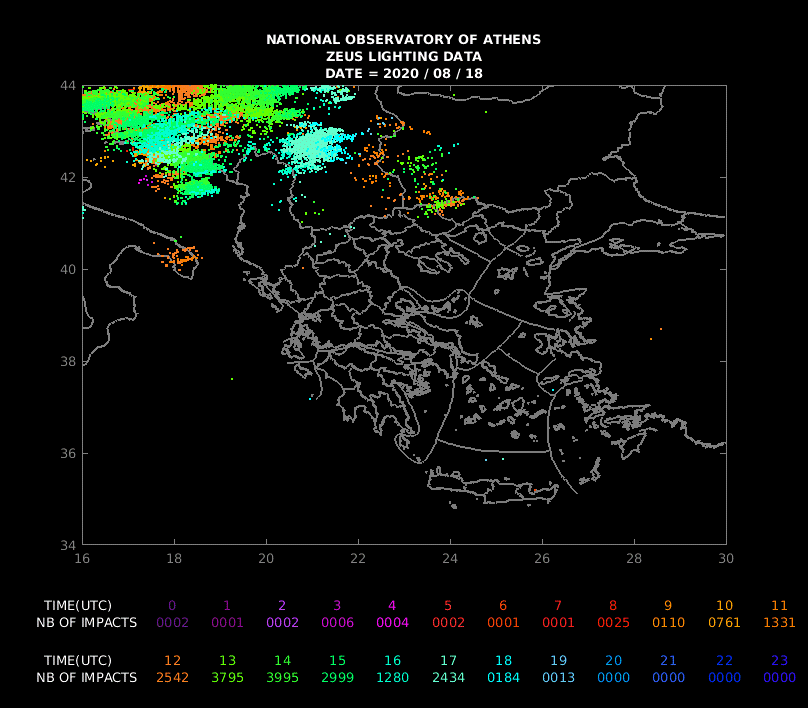
The ZEUS lightning detection network, operated by the Institute for Environmental Research and Sustainable Development (IERSD), is one of the most advanced systems for monitoring lightning activity in Europe. Operational since 2005, the network comprises six detection stations at strategic locations across Europe and the Mediterranean: Chilbolton (England), Roskilde (Denmark), Iași (Romania), Alexandria (Egypt), Larnaca (Cyprus), and Mazagón (Spain). IERSD is one of the few Greek research institutes that maintains and operates specialized measurement equipment outside Greece. The network’s measurements and real-time lightning detection across Europe and the Mediterranean are presented on the website https://www.meteo.gr/thunders.cfm.
Detection Technology and Methodology: The ZEUS system is based on recording the low-frequency electromagnetic radiation (5 – 15 kHz) emitted when an electrical discharge makes contact with the ground. Each electrical discharge creates a unique waveform (“sferic”). However, for the precise geographical localization of a discharge, simultaneous recording by at least four stations is required. When lightning strikes the ground, the signal waveform reaches each station at a different time, depending on the station’s distance from the event location. The system designates one station as a “reference station” and assigns it a zero signal arrival time difference. Subsequently, the arrival time differences of the signals at the other stations are calculated. The lightning’s location is determined using geometric calculations, based on the hyperbolic intersection method. The arrival time differences between the reference station and the other stations define hyperbolic curves, and the intersection point of these hyperbolas corresponds to the geographical position of the electrical discharge.
Contribution to Research and Operational Monitoring: The ZEUS network provides valuable data for understanding lightning activity and contributes to both scientific research and the improvement of operational extreme weather forecasting systems. Its operation enhances the study of atmospheric electrical activity and supports critical sectors such as civil protection and natural disaster management.