






Sensor Networks for Air Pollution Monitoring
Aiming to utilize systems incorporating modern air quality monitoring sensor technology, the IERSD/NOA has developed, since 2018, measurement networks in the wider Attica region and other areas of Greece. It also conducts measurement campaigns with portable instruments for urban pollution mapping and assessing the population’s personal exposure. The main infrastructures used in the context of these activities are:

Low-cost PM2.5 sensor networks: For PM2.5 data collection, PurpleAir PA-II instruments are used, which are based on optical particle counting sensors across multiple size categories. The IERSD/NOA has conducted extensive tests of the PA-II in various environments and under different pollution conditions, providing concentrations calibrated against reference instruments. Through the online platform air-quality.gr, developed on a multi-virtual machine information system of the NOA, a cartographic representation of real-time concentrations recorded in the network is provided for all measurement locations of the PANAKEIA National Research Infrastructure.
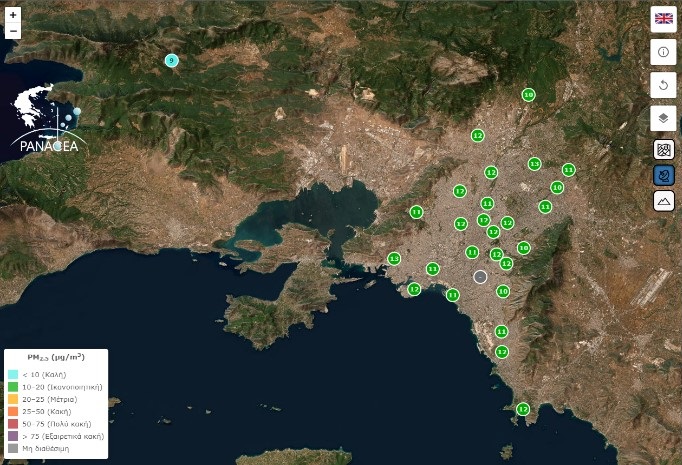
Sensor systems for monitoring multiple pollutants: The IERSD/NOA has established a network of medium-cost sensor systems in the Attica Basin for the simultaneous, real-time monitoring of gaseous and particulate pollutants. The network was developed by installing instruments at one traffic site and 5 other residential background sites, in each of the regional units of Attica. AQMesh type instruments are used, which can record concentrations of multiple regulated pollutants (CO, NO, NO2, O3, SO2, PM2.5, PM10), at a significantly lower cost compared to standard methods.
Portable instruments for mobile measurements and personal exposure assessment: For measuring the concentration of black carbon (BC) in atmospheric aerosols, as well as their absorption across multiple wavelengths, portable Aethlabs MA200 and MA350 micro-aethalometers are used in mobile measurements to characterize spatial variation. The spectral absorption data allow for continuous characterization of important parameters, such as brown carbon (BrC) and the source apportionment of black carbon (biomass burning, fossil fuel combustion). Additionally, portable Naneos Partector 2 instruments are used to measure the number, size, and surface area of ultrafine particles (UFP). The portable instruments are calibrated by comparison with corresponding reference instruments at the NOA’s Superstation in Thissio.